Dog Peed on Your Oriental Rug? What to Do Next
A Southwest Florida Oriental & Persian Rug Resource Center Guide from Oriental Rug Salon
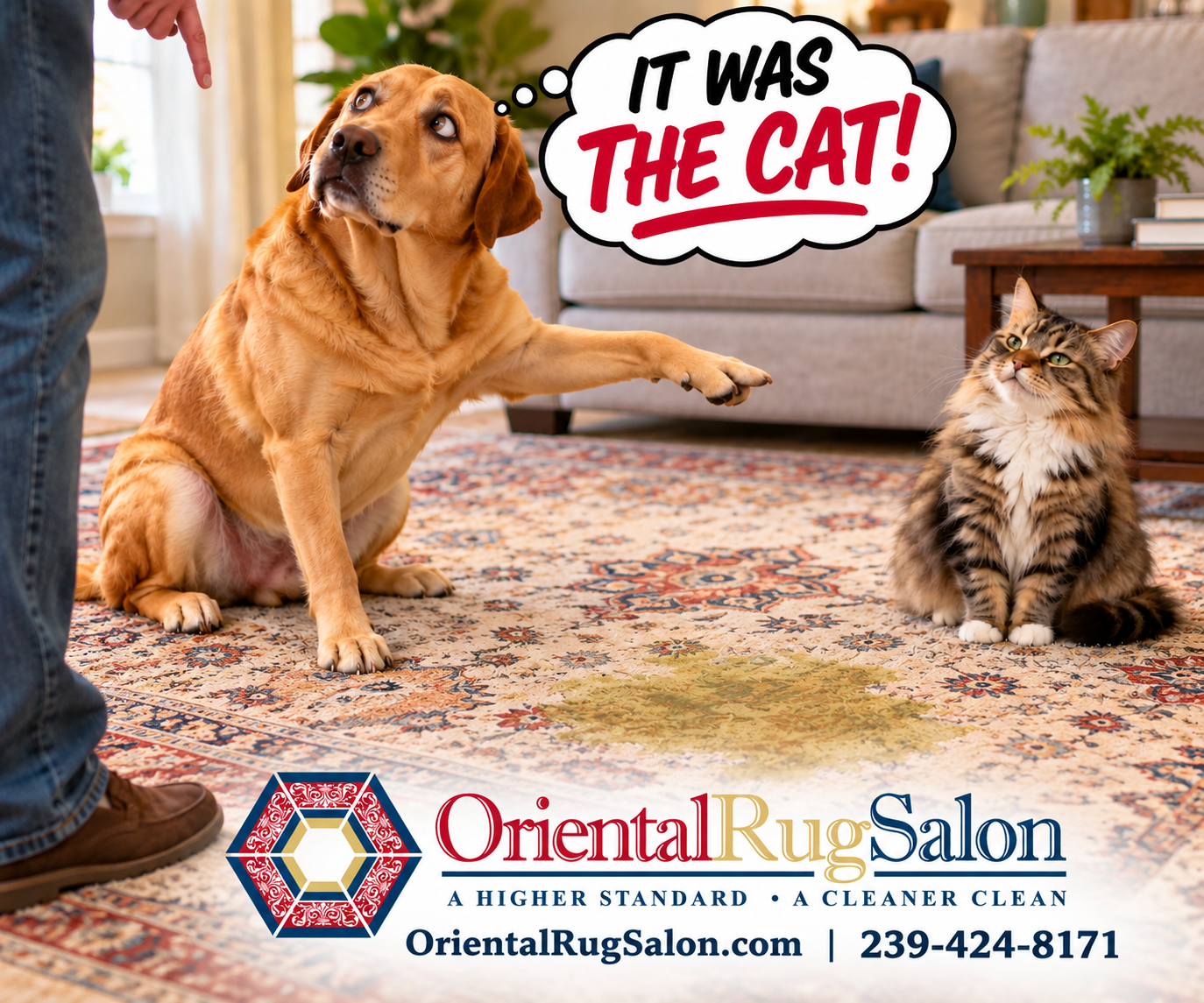
You hear the sound. You look across the room. And there stands your dog beside your beautiful Oriental rug with that unmistakable expression.
Then you see it.
Your dog just peed on your Oriental rug.
What you do next matters.
A pet accident on an ordinary washable floor covering is one thing. Dog urine on a handmade wool, silk, Oriental, or Persian rug is entirely different.
Reaching for a bottle of carpet cleaner, pet stain remover, vinegar, peroxide, baking soda, or another internet-recommended remedy can potentially turn a manageable accident into permanent damage.
The good news is that one pet accident doesn’t necessarily mean your rug is ruined.
At Oriental Rug Salon, we’ve helped Southwest Florida rug owners deal with pet accidents and urine contamination for years. The most important advice we can give you is simple:
Don’t panic, don’t scrub, and don’t start experimenting with household chemicals.
Here’s what you should do instead.
First: Blot the Urine—Don’t Rub It
If you discover the accident while the area is still wet, acting quickly can reduce how deeply the urine penetrates the rug.
Use clean, white, absorbent towels or paper towels.
Place them directly over the wet area and gently press downward.
Blot. Don’t scrub.
Replace the towels as they absorb moisture and continue until you’re no longer pulling significant moisture from the rug.
If possible, check underneath the rug as well.
Urine can pass through the wool pile and foundation and reach the rug pad or flooring underneath.
That’s one reason pet urine problems are often larger than they appear from the surface.
Why shouldn’t you rub the spot?
Aggressive rubbing can spread the contamination into a larger area. It may also distort wool fibers or potentially contribute to dye movement in susceptible rugs.
Your goal isn’t to “scrub out” the urine.
Your immediate goal is simply to remove as much liquid as possible without making the situation worse.
Don’t Reach for the Grocery-Store Pet Stain Remover
This is where well-intention rug owners sometimes get into trouble.
You see a bottle promising to eliminate pet stains and odors, so naturally it seems like the right solution.
But an Oriental or Persian rug isn’t the same thing as synthetic wall-to-wall carpeting.
Handmade rugs may contain:
- Wool
- Silk
- Cotton
- Natural or specialty dyes
- Multiple colors with different dye stability
- Hand-knotted foundations
Specialty fibers that respond differently to moisture and cleaning chemistry
A product that performs acceptably on synthetic carpet could potentially cause problems on a fine rug.
These can include discoloration, dye migration, fiber damage, residue, bleaching, or setting a stain that might otherwise have been professionally treatable.
Never assume that a product labeled “safe for carpet” is automatically safe for an Oriental or Persian rug.
Please Don’t Put These DIY Remedies on Your Oriental Rug
Internet searches produce an endless collection of home remedies for dog urine.
Some may work acceptably on certain washable household materials. That doesn’t mean they’re appropriate for a valuable wool or silk rug.
We recommend avoiding DIY experiments involving:
Bleach
This should never be your first response to a pet accident on a fine rug. Bleach can permanently alter colors and damage fibers.
Hydrogen peroxide
Peroxide has bleaching and oxidizing properties. Depending upon the rug and dyes, the resulting color change may be more noticeable than the original accident.
Vinegar
Vinegar is frequently a DIY solution pet urine and odors. However, applying homemade cleaning mixtures without knowing the rug’s fiber and dye characteristics can create unnecessary risks. Click here to discover how to safely use vinegar in an emergency situation.
Baking soda
Powders can become embedded deep within a rug’s pile and foundation and may be difficult to remove completely.
Dish washing detergent
Dish soap wasn’t formulated for rinsing from fine Oriental rugs. Excess detergent can leave residue that attracts soil.
Household carpet shampoo
A cleaner intended for synthetic residential carpet shouldn’t automatically be considered appropriate for wool, silk, viscose, or specialty rug fibers.
Steam cleaners and portable carpet machines
Adding more moisture and cleaning chemistry without thoroughly rinsing and drying the rug can spread contamination deeper into the rug.
When you’re dealing with a treasured Oriental rug, experimentation can be expensive.
Why Dog Urine Can Be So Difficult to Remove From an Oriental Rug
A fresh pet accident contains mostly liquid.
But the problem changes as urine dries.
Urine contamination can migrate downward through the face fibers and into the rug’s foundation. As moisture evaporates, urine residues and salts remain behind.
That helps explain a frustrating situation we hear about frequently:
“I cleaned the spot, and it looked fine, but a few days later I could smell it again.”
The surface may have been cleaned while contamination such as bacteria and urine salts remained deeper inside the rug.
Southwest Florida’s warm, humid environment can make lingering odor problems especially noticeable.
A rug can look clean from the top while urine contamination remains within its structure.
That’s why simply spraying deodorizer onto the surface often doesn’t solve the underlying problem.
Covering an odor isn’t the same as removing its source.
Did You Know: Many wool oriental rug fibers feature a hollow, core-like inner structure known as the medulla. Urine salts and bacteria can become trapped and protected by the wool’s outer core, which is why DIY odor-removal efforts often fail. The exterior wool fiber protects the source of the odor.
Why Does My Oriental Rug Smell Worse When It’s Humid?
Southwest Florida rug owners sometimes notice pet odors become more apparent during periods of high humidity.
That’s not necessarily their imagination.
Environmental moisture can make previously deposited urine residues more noticeable.
A rug that seems relatively odor-free in one environment may smell considerably different when humidity increases.
That’s particularly relevant for homes throughout:
Cape Coral, Fort Myers, Naples, Bonita Springs, Estero, Marco Island, Punta Gorda, Port Charlotte, Sanibel, and surrounding Southwest Florida communities.
If the odor repeatedly disappears and returns, the source of the problem likely hasn’t been completely removed.
“But I Can’t See a Stain. How Do I Know Where My Dog Went?”
Sometimes you know exactly where the accident happened.
Other times you simply walk into the room and think:
“Something smells.”
This becomes particularly challenging when a pet has repeatedly marked a rug.
Several contaminated areas may be hard to see under normal household lighting.
Professional rug specialists can use specialized inspection methods to identify areas that need extra attention.
At Oriental Rug Salon, inspection is an important part of determining what a rug needs before washing begins.
Finding the contamination matters because treating only the obvious spot may leave other odor sources behind.
Should I Take My Oriental Rug Outside and Hose It Down?
We don’t recommend it.
Professional rug washing isn’t simply “getting the rug wet.”
Before washing a fine Oriental or Persian rug, a trained rug-care professional should consider several factors, including:
- Fiber content
- Construction
- Dye stability
- Existing damage
- Previous repairs
- Fringe condition
- Pet contamination
- Staining
- Age and overall condition
Some rugs tolerate water extremely well when handled properly.
Others require special precautions.
Proper drying is equally important.
A saturated rug left to dry slowly in Southwest Florida’s humidity can develop an entirely new set of problems.
Why Professional Rug Cleaning Is Different From Cleaning Carpet
One of the most important distinctions for consumers to understand is this:
An Oriental rug shouldn’t be treated like wall-to-wall carpet.
Wall-to-wall carpeting generally must be cleaned where it is installed. You should never allow a carpet cleaning company the opportunity to clean your Oriental or Persian area rug and here’s why.
An area rug should be transported to a specialized rug-cleaning facility where rug cleaning professionals have greater control over inspection, cleaning, rinsing, and drying.
This is especially important when urine has penetrated below the surface.
Simply cleaning the top of a urine-contaminated rug may improve its appearance without addressing deeper contamination.
For significant pet contamination, a professional rug-cleaning process can address much more than the visible surface.
What Happens When Oriental Rug Salon Receives a Pet-Contaminated Rug?
Every rug is different, so treatment should be based on the individual rug rather than a one-size-fits-all recipe.
At Oriental Rug Salon, the process begins with inspection.
We evaluate the rug’s construction, fibers, dyes, condition, and areas of concern.
When appropriate, we evaluate dye stability using a 24-hour color fastness test before washing.
Dry particulate soil should also be addressed because an astonishing amount of sand, grit, dust, pet hair, and other materials can become trapped within a rug even after vacuuming. Each rug we clean receives a safe dusting at 40,000 harmonic vibrations per minute to release years of deep-set dirt, sand, pollen, and dust mites.
Pet-contaminated rugs may then require specialized treatment designed to address urine deposits rather than merely perfume the rug. Rugs treated for pet urine contamination at Oriental Rug Salon receive a specialized enzymatic bath before the cleaning process begins. We release enzymes throughout the area rug that attack the bacteria in urine, vomit, and feces to eliminate the contaminating source of odor and bacteria.
We thoroughly wash and rinse the rug using procedures appropriate to its construction and condition.
Controlled drying is also critically important. We dry all rugs in a humidity-controlled room where air is heated and circulated while dehumidifiers extract moisture, ensuring a quick drying process.
Finally, the rug receives a post-cleaning inspection and the nap is groomed before it is prepared for return to its owner.
The objective isn’t:
“Make the rug smell like perfume.”
The objective is to address the source of the contamination.
What If My Dog Has Peed on the Rug More Than Once?
Tell your rug cleaner.
Seriously.
There’s absolutely no reason to be embarrassed.
We work with pet owners all the time.
Knowing that a dog has repeatedly used a particular rug helps the rug-care specialist understand what may be happening beneath the surface.
Repeated urine exposure can be significantly different from treating one recent accident.
It may affect:
- Face fibers
- Dyes
- Cotton foundation
- Fringe
- Rug pad
- Flooring underneath the rug
The more information you provide, the better we can evaluate the situation.
And yes—we love dogs too.
Can Dog Urine Permanently Damage a Wool or Silk Oriental Rug?
Unfortunately, it can.
That doesn’t mean every pet accident causes permanent damage.
The outcome depends upon factors such as the rug’s materials, dyes, length of exposure, amount of contamination, previous cleaning attempts and frequency of accidents.
This is another reason early professional attention is preferable to repeatedly applying household chemicals.
Sometimes the urine isn’t what causes the most visible permanent damage.
The rug owner’s attempt to remove it does.
What About the Rug Pad Underneath?
Don’t overlook it.
If urine traveled completely through your Oriental rug, the pad beneath it may also be contaminated.
Returning a professionally cleaned rug to a urine-contaminated pad doesn’t make much sense.
Depending upon the severity of the accident and type of padding, the pad may need to be professionally addressed or replaced.
The floor beneath the pad should also be inspected.
This is particularly important when repeated pet accidents have occurred in the same location.
How Can I Stop My Dog From Returning to the Same Spot?
Dogs have an extraordinary sense of smell.
Even when you can’t detect the previous accident, your dog may still be able to.
That’s another reason simply masking an odor isn’t necessarily enough.
Removing contamination as completely as practical will help reduce residual odor cues.
However, repeated accidents can also involve behavioral or medical issues. If a previously house-trained dog suddenly begins urinating indoors, consider discussing the change with your veterinarian.
My Dog Just Peed on My Persian Rug. What Should I Do Right Now?
Here’s the short version:
Blot up as much liquid as possible using clean white absorbent towels.
Don’t scrub the rug.
Mix a solution of 50% WHITE vinegar and 50% cool water. Dab a white washcloth or paper towel to moisten, then test the rug’s dye stability in an inconspicuous area. Lightly press the towel or paper cloth with the solution onto a small area of the rug for a couple of minutes, then check whether any dye transferred. If no transfer occurs, lightly saturate the pet accident with the solution, let it sit for about 5 minutes, then continue blotting with a white towel (or paper towel) until almost dry. Finish drying the area by using a hair dryer on cool or place a fan on the area. If the odor persists, contact Oriental Rug Salon.
Don’t apply bleach, peroxide, household carpet cleaner, or random internet remedies.
Check whether urine penetrated through to the rug pad and flooring.
Keep people and pets away from the affected area.
Contact a professional Oriental rug cleaner, particularly for valuable, handmade, wool or silk rugs.
Most importantly:
Don’t panic.
Pet accidents happen.
The sooner you evaluate the situation correctly, the better.
Frequently Asked Questions About Dog Urine and Oriental Rugs
Can I use store bought enzyme cleaner on my Oriental rug?
Commercial-grade enzyme products can be useful in professional pet-contamination treatments, but not every retail enzyme product is appropriate for every Oriental rug. Fiber type, dyes and construction matter. Don’t assume a product is safe simply because the label mentions pet urine. It should also be noted that most over the counter, big box or grocery store pet urine products are water downed and ineffective on wool and silk area rugs.
Will professional cleaning completely remove dog urine odor?
The outcome depends upon the extent and age of contamination, rug construction, previous treatments and whether urine has affected other materials. A professional inspection provides a much better basis for determining what can reasonably be achieved.
Can urine cause the colors in my Oriental rug to bleed?
Yes! Urine, moisture, cleaning products and unstable dyes can create complicated situations. That’s one reason dye stability should be considered before aggressive cleaning.
Can a wool rug be washed?
Many wool Oriental rugs can be professionally washed very successfully. However, the proper method depends upon the individual rug’s construction, dyes and condition.
How quickly should I have my rug professionally cleaned after a pet accident?
Sooner is generally better. Immediately blot fresh urine and contact a rug-care professional if you’re dealing with a valuable or delicate rug. Repeated DIY treatments can make professional correction more difficult.
What if the urine accident happened months ago?
Don’t assume it’s too late. Older contamination may still be treatable, although the age and severity of the problem can affect the result. Have the rug professionally inspected.
Why did the urine smell come back after my carpet cleaner cleaned the rug?
Surface cleaning may not always reach contamination that migrated into the rug’s foundation or pad. Odor can therefore reappear even when the face of the rug looks clean.
Your Rug Is Valuable. Your Dog Is Family. You Don’t Have to Choose Between Them.
At Oriental Rug Salon, we understand something every pet owner knows:
Accidents happen.
Your dog doesn’t need to be in the doghouse, and your Oriental or Persian rug doesn’t necessarily belong in the trash.
Since 2007, Oriental Rug Salon has helped Southwest Florida families care for Oriental, Persian, wool, silk and other fine area rugs.
Our specialized rug-cleaning facility allows us to inspect, test, clean, rinse and dry rugs in a controlled environment rather than simply treating the exposed surface inside your home.
We serve rug owners throughout Cape Coral, Fort Myers, Naples, Bonita Springs, Estero, Marco Island, Sanibel, Captiva, Punta Gorda, Port Charlotte and surrounding Southwest Florida communities.
If your dog just had an accident on your Oriental rug—or you’ve been trying to figure out where that mysterious pet odor is coming from—give us a call.
Southwest Florida’s Oriental & Persian Rug Care Specialists
Visit Us Online: OrientalRugSalon.com
Visit Us On Facebook: https://www.facebook.com/OrientalRugSalon/
This article is part of Oriental Rug Salon’s Southwest Florida Oriental & Persian Rug Resource Center, created to help rug owners better understand, protect and preserve their Oriental, Persian and other fine area rugs.
Have a rug-care question you’d like us to answer in a future article? Contact Oriental Rug Salon. Your question may become our next Resource Center guide.